
The Backyard – New Traxxas Stampede and RC 101
Greetings all and Happy Friday! Welcome to The Backyard!
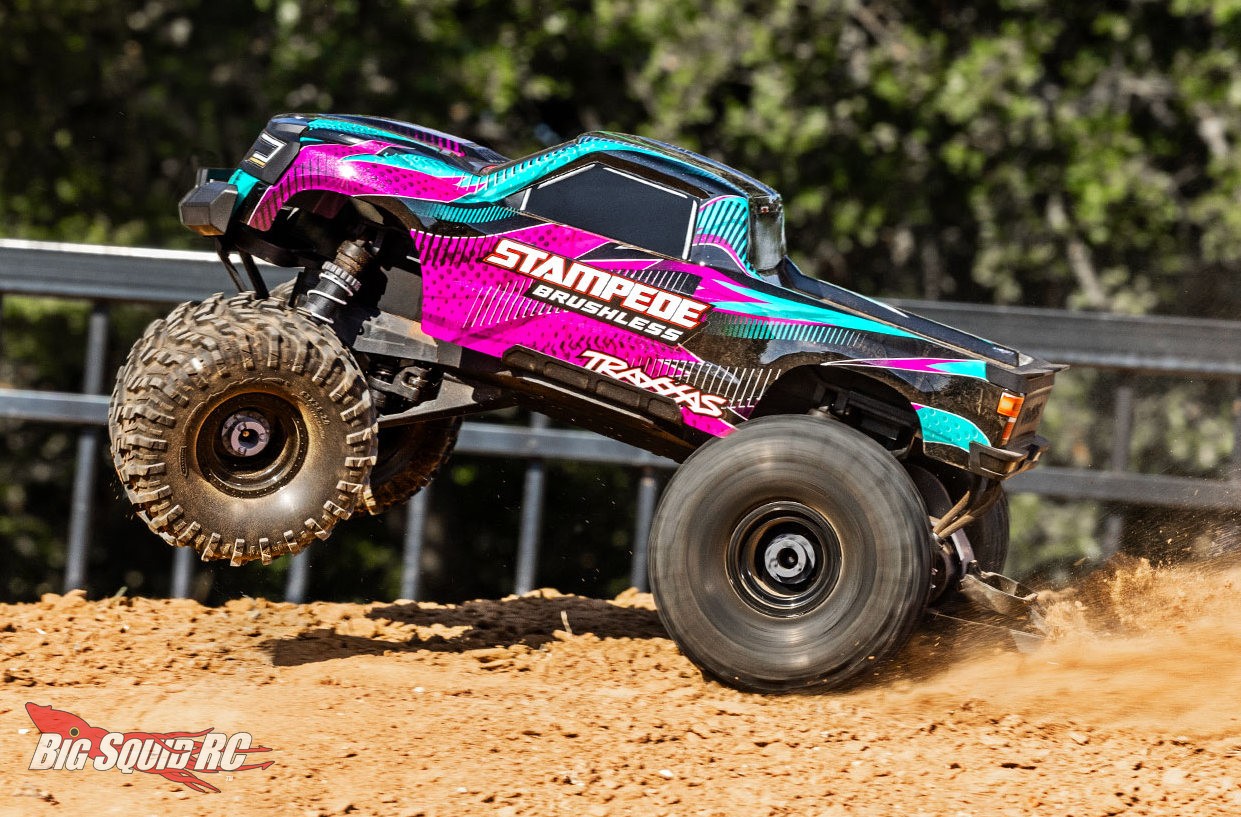
Well friends, the Traxxas Stampede is getting updated again.
Seeing the latest version of the Stampede immediately got my attention because I go WAY back with this truck. I was actually waiting for the original Stampede to be released, and my first one came as a kit. That should give you some idea of how long I’ve been messing around with these things.
And this latest Stampede isn’t just a new body and electronics package. Traxxas has given the 2WD truck a new monocoque chassis with a longer and wider footprint, redesigned suspension and steering, composite GTR shocks, beefier 32-pitch gearing, and a new clipless body system. Power comes from the new 3S-capable VX3 brushless system. In other words, they’ve done quite a bit here.
What I like is that despite all of those changes, the basic idea behind the Stampede hasn’t really changed. It’s still a big-tired, rear-motor 2WD monster truck that’s designed for blasting around the backyard, popping wheelies in the street, and generally being abused in ways that probably weren’t mentioned in the owner’s manual.
And that last part is important, because the Stampede has also spent decades being something else: a lot of people’s first hobby-grade RC.
That brings me to something I saw recently on an RC message board I frequent. I came across some newer hobbyists asking questions about their Stampedes. These were basic questions about things like gearing, spur gears, slipper clutches, and general setup, and it occurred to me that I probably don’t talk about this kind of stuff enough.
I’ve been doing hobby-grade RC since I was a kid, and I’ve been writing about this stuff for a very long time. Most of the people I regularly talk RC with have also been doing it for years. It’s really easy to forget that there are constantly new people coming into this hobby who don’t know what a spur gear is, much less how tight their slipper clutch should be.
So maybe every now and then The Backyard should actually contain some useful advice! And what better place to start than the Stampede?
If you’ve recently bought a Stampede—or really any similar hobby-grade basher—one of the first things I’d recommend learning is how the drivetrain works. You don’t need to become an RC transmission engineer, but understanding a couple of basic things can save you a lot of frustration.
Let’s start with the humble spur gear.
If you’re new to RC and strip a plastic spur gear, your immediate reaction may be that you need to replace it with a metal one. After all, metal is stronger than plastic, so that’s an upgrade, right?
Not necessarily.
Plastic spur gears work just fine, and if you’re repeatedly destroying them, there’s probably something else going on. Learn how to properly set the gear mesh between your pinion and spur. Too tight and you’re creating unnecessary heat and wear. Too loose and you’ll start chewing teeth off the spur gear. Once you learn what proper gear mesh looks and feels like, it’s something you’ll be able to set pretty quickly for the rest of your RC career.
And while you’re poking around in there, learn what your slipper clutch does. The slipper clutch is designed to slip. That’s not a defect. It’s right there in the name! It helps absorb sudden loads in the drivetrain rather than sending every bit of that shock through the gears, shafts, and everything else downstream.
A common beginner instinct is to tighten the thing down because slipping must mean you’re losing power. And yes, you can adjust a slipper depending on what you’re doing with the truck. But cranking it down as tight as possible can simply move the stress somewhere else in the drivetrain.
There’s another bit of advice that applies here: try not to land jumps while holding the throttle wide open. We’ve all done it, and sometimes you don’t have much choice, but landing under full power can send a pretty good shock through the drivetrain. Your Stampede may be built for backyard stupidity, but mechanical sympathy still goes a long way.
And if you do eventually strip a plastic gear or break something, don’t immediately assume every plastic component needs to be replaced with aluminum or steel. Sometimes plastic is exactly what you want. An inexpensive part giving up the ghost can be a lot better than transferring all of that force into a more expensive component farther down the line.
The funny thing is that none of this feels particularly noteworthy to those of us who have been doing RC forever. Gear mesh? Slipper clutch? Plastic spur gear? This is RC 101 stuff.
But everybody has to take RC 101 at some point.
There was a time when I didn’t know any of this stuff either. Somewhere out there right now is somebody opening their first hobby-grade RC, and there’s a pretty decent chance that RC might have the word Stampede written on the side of it.
So with another generation of Stampede arriving, maybe it’s a good time for those of us who have been around awhile to remember that not everyone reading RC websites and message boards has been doing this for decades. There are still plenty of new people coming into the hobby, and that’s a very good thing.
Maybe I’ll make beginner tips an occasional feature here in The Backyard. Nothing too technical, mind you. I don’t want anyone getting the impression that I’ve suddenly become responsible!
But after all these years, I’ve certainly broken enough RC vehicles to have learned a few things about how NOT to break them. And it probably doesn’t hurt to share some of that advice more frequently for the noobs in the room!
Alright, that’s it for me this week. Until next time, keep it on all 4’s!