
The Backyard – What Makes a Good Re-Release?
Greetings all and Happy Friday! Welcome to The Backyard!
Friends, we are living in the golden age of the re-release. Tamiya and Team Associated in particular have been digging deep into their respective back catalogs in recent years, bringing back all sorts of vehicles that many of us grew up building, racing, bashing, or simply staring at longingly in hobby shop display cases.
And I’m certainly not complaining! All of these old kits coming back has gotten me thinking, though: what actually makes for a good re-release?
The first part is pretty obvious. There needs to be a reason to bring the vehicle back in the first place. Maybe it was massively popular. Maybe it had an important place in RC history. Maybe it was successful on the racetrack. Or perhaps it wasn’t particularly successful at all, but developed a cult following over the years. Whatever the reason, there needs to be something about the original that still makes people care about it decades later.
But that’s just what makes a re-release viable. What makes a re-release GREAT, at least in my opinion, is when a manufacturer understands what people loved about the original while also recognizing the things that weren’t so great.
There’s a fine line here. I don’t want a vintage re-release so heavily modernized that it becomes a completely different vehicle wearing an old body. Part of the fun of building one of these things is experiencing the engineering, quirks, and driving characteristics of the original. But I also don’t think authenticity requires faithfully reproducing every problem from 1987.
If an old design was notorious for popping dogbones, for example, I’m perfectly happy to see a modern re-release use CVDs or universals. Nobody is going to open the box, see those and yell, “BUT WHAT ABOUT THE AUTHENTIC DOGBONE EXPERIENCE?!”
Preserve the quirks. Fix the problems.
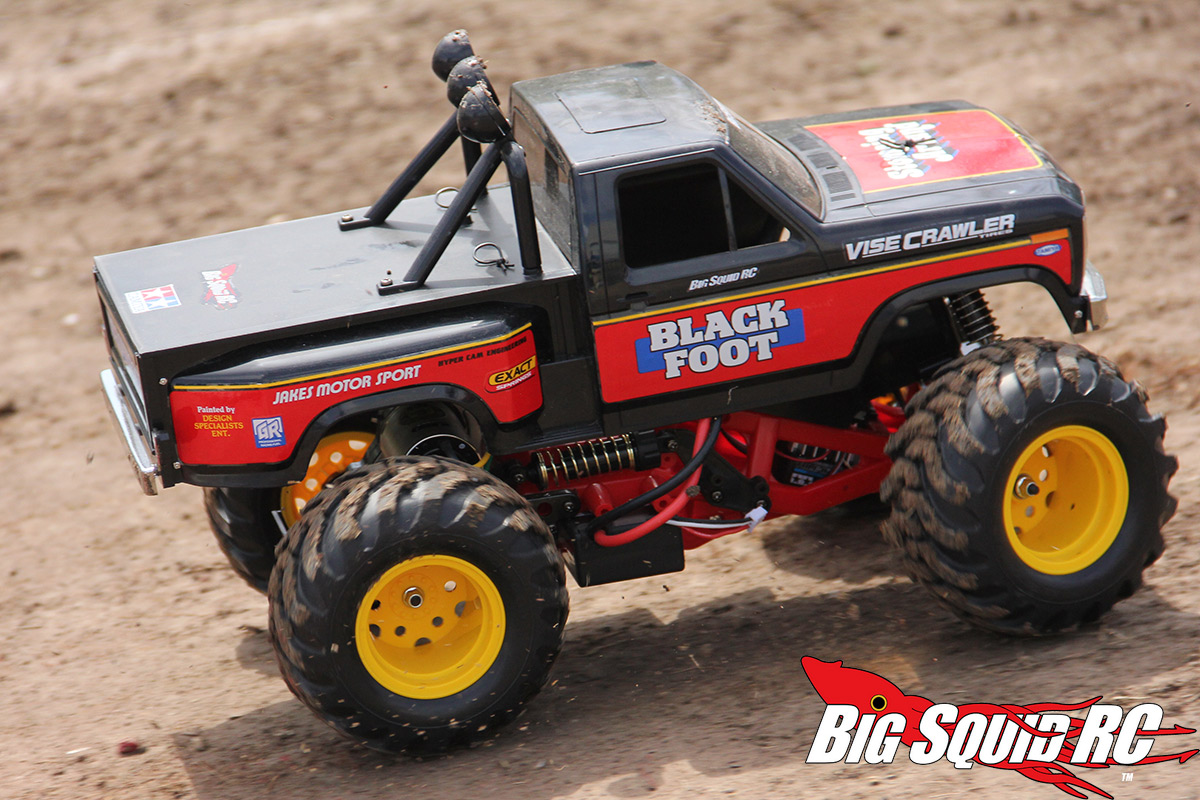
Tamiya’s 2016 Blackfoot is a great example of what I’m talking about. The original Blackfoot had a notoriously troublesome hex-drive setup that could wear and cause all sorts of headaches. When Tamiya brought the Blackfoot back, they addressed it. The re-release still looked, built, and felt like a Blackfoot, but one of the original truck’s biggest weaknesses didn’t need to come along for the ride. Nobody was nostalgic for stripping Blackfoot drive parts.
That’s the kind of update I love seeing in a re-release.
Unfortunately, my beloved Clod Buster provides a recent example of the opposite. Long-time readers know the Clod is my favorite RC of all time, and I was thrilled when Tamiya announced the latest version with the classic red plastic, white wheels, and original-style presentation. I’m still buying one.
But the Clod has also had some well-known shortcomings for nearly four decades, with the steering setup being chief among them. This latest re-release would’ve been the perfect opportunity to address that, but they didn’t. The same goes for things like bearings and oil-filled shocks. I don’t think including those things would fundamentally change what a Clod Buster is. They’d simply make a classic design better to build and drive in 2026.
And that’s really where I draw the line with these things. I want a re-release to feel like the original. I don’t necessarily need it to frustrate me like the original.
There’s a difference between a quirk and a flaw. Weird suspension geometry, unusual chassis layouts, strange handling characteristics and other bits of old-school engineering can be part of what gives a vintage RC its personality. A component that everybody immediately replaced because it didn’t work particularly well? Fix it!
That’s why I think manufacturers have an interesting responsibility when bringing these old vehicles back. Preserve enough of the original engineering that we’re still getting the experience we remember—or, for younger hobbyists, the experience they’ve heard about—but take advantage of the decades of knowledge we’ve accumulated since then.
Sometimes that might mean changing very little. Sometimes it might mean swapping dogbones for CVDs, adding bearings, strengthening a known weak point, or improving a steering setup that wasn’t particularly good when Ronald Reagan was president. Just don’t go so far that the original vehicle disappears in the process.
Preserve the quirks. Fix the problems.
Because at the end of the day, I think a great re-release should remind you why you loved the original—not why you upgraded it.
That’s it for me this week. For all of the readers in the States, enjoy a long holiday weekend! Until next time, keep it on all 4’s!